
During our webinar, “Winning Routes: Optimizing Transmission and Interconnections to Reduce Conflict and Delay”, Ben Browning, WPIT walked through a practical framework for improving routing studies from the very beginning of a project. His message was clear: the earlier teams identify constraints, risks, and opportunities, the faster they can make defensible decisions and avoid costly redesigns later.
As Browning explained, “time is money,” and one of the biggest causes of delay is treating routing inputs sequentially instead of concurrently. By working through the right layers at the same time, teams can reduce friction, spot issues sooner, and build a route that is easier to defend with landowners, regulators, and stakeholders.
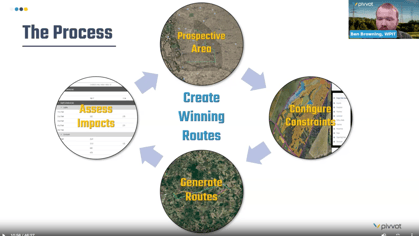
Step 1: Define the objective path
The first step is identifying the prospective area. In other words, determining the start and end points, or the full set of points that need to be connected. Ben emphasized that this is where routing begins, but it’s also where exclusions should start to take shape, since teams should already know where they absolutely do not want to go.
Within Pivvot, this becomes the objective path, which can be built around multiple start and end points depending on project needs. Ben noted that it’s important to define exclusion areas early, whether those are sensitive landowners, restrictive jurisdictions, or places that are known to create problems later in the process.
Step 2: Configure constraints
Once the objective path is set, the next step is to configure constraints. Ben described this as one of the most important parts of the workflow, because routing decisions often hinge on environmental, engineering, land use, and stakeholder considerations that must be weighed together.
He introduced Pivvot’s PLAE approach: Prefer, Low Avoidance, Avoidance, and Exclusion — as a way to assign importance to different datasets and turn complex routing inputs into a more manageable decision-making framework. As Ben put it, the goal is to “show your work” and make the route defensible by clearly documenting why certain areas were preferred, avoided, or excluded.
Step 3: Generate route options
After constraints are configured, teams can generate routes in several ways: manually drawing them, uploading known routes, or using an algorithm to create them. Ben pointed out that each method has value, but the real advantage comes from comparing them side by side in one platform.
That comparison is especially helpful when teams need to test alternatives quickly. Ben shared that algorithm-driven routes can get teams “90% of the way there,” while manual refinement can help solve the final problem areas. In practice, that means faster iteration and a better foundation for design collaboration.
Step 4: Assess and communicate impacts
The final step is evaluating the impacts of each route and turning those findings into something usable. Ben highlighted several outputs that matter in real project workflows, including parcel analyses, detailed constraint reports, KMZ files, elevation profiles, and suitability corridors.
This step is not just about analysis. It’s about communication. As Ben explained, teams need to be able to show landowners, regulators, and internal stakeholders how a route was developed and why it is the best available option. That visibility helps build trust and can support a smoother permitting process.
Why the process matters
A strong routing workflow is rarely a straight line. As Ben noted, the first iteration is usually not the final version, which is why the process needs to be iterative and flexible. New exclusions may emerge, constraints may change, and route options may need to be adjusted as project priorities evolve.
The biggest takeaway from the webinar was that better routing starts with better information, better visualization, and better collaboration. Or, as Ben and JJ emphasized, the key is not just to choose a route — it’s to understand, defend, and communicate why that route makes sense.
Ready to get started?
If you have an upcoming project and want to streamline routing analysis, reduce risk, and make faster, more defensible decisions, request a demo from a Pivvot expert.
Additionally, if you missed the webinar, you can watch the full recording or catch the highlights here!